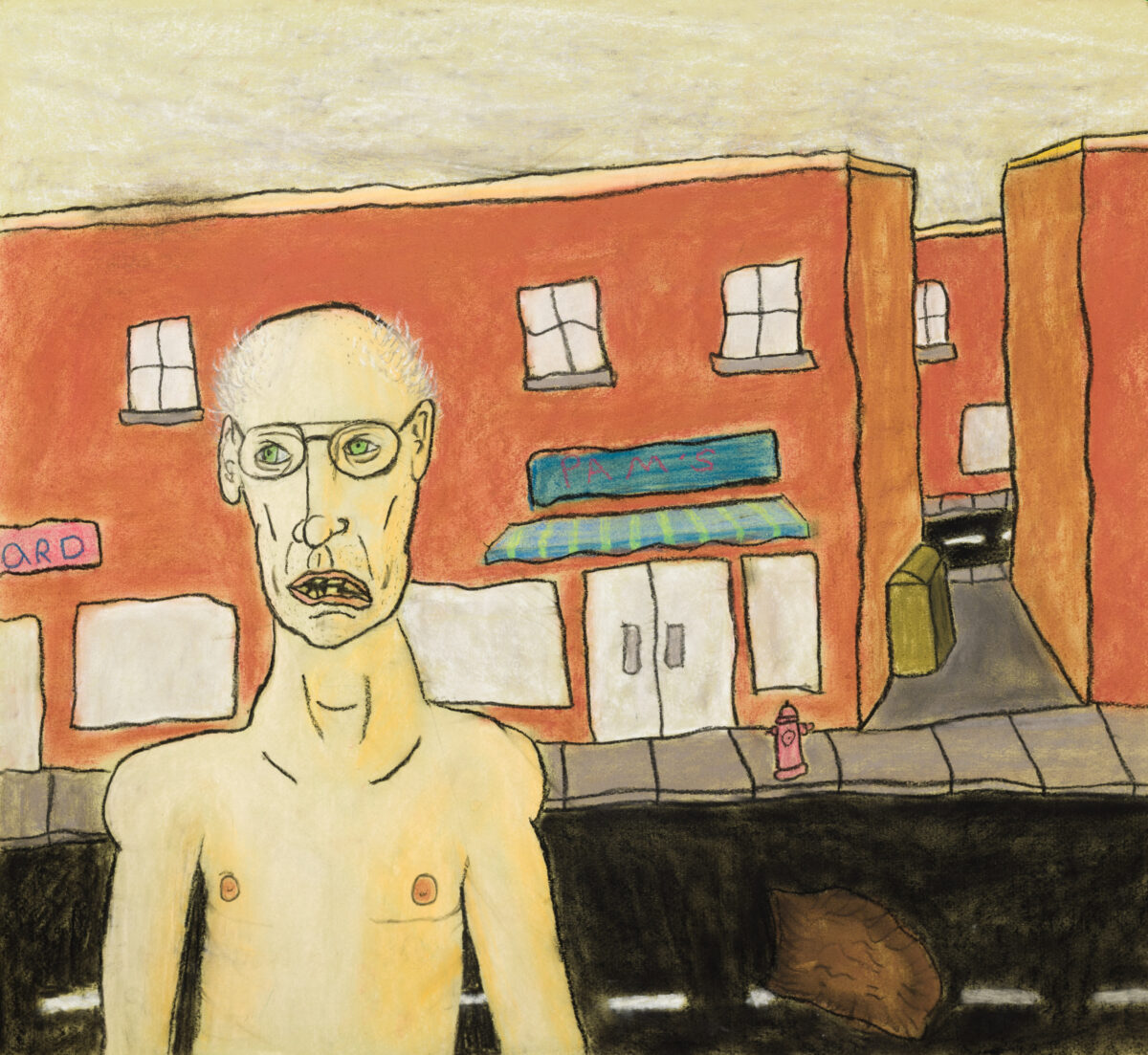
I drew this in 2008 for an elective class I had at Berklee called “John Lennon Songwriting,” where we learned all about the Beatles, John, and his solo career.
This depicts the character from the song of the same name on Abbey Road. The ten bob note in his nose, saving up to buy some clothes, the hole in the road where he sleeps, and the shop where his sister, Pam, works are all in the picture. A ten bob note is a ten shilling note, currency in England until they stopped using it in 1970.
I drew this my senior year of high school, in my second year of AP Art. My concentration was “Life as a Musician,” because I was very in love with music at the time, and I still am. I had also decided by then that I wanted to go to Berklee, so I drew what I thought life as a songwriter and gigging musician would be like.
Its themes were record contracts and dealing with industry greed, addiction, hard work, insecurity, and celebrity, among others. Loading In was the hard work piece.
Unfortunately, this is the only piece from the concentration that survives. It isn’t my favorite of the lot, but I guess it’s something to remember the whole thing by.
I have a folder on my hard drive full of MIDI music memos and rough recordings — ideas I’ve captured and then completely forgotten about. Every once in a while I’ll dig back through it, and something will stop me. Something I made a year ago, maybe two, that sounds fresh and surprising in a way I couldn’t have heard when I made it. I was too close to it back then and I couldn’t tell what it actually was.
I’ve always known this feeling. I didn’t know it had a name until I read the introduction to Ray Bradbury’s The Martian Chronicles.
Written in 1950 right after he turned in the final manuscript, Bradbury’s essay “How I Wrote My Book” was found in his home office files decades later and eventually published as part of the book’s deluxe edition. It’s not long. But it covers more ground than most books do — and the way it moves from one idea to the next is what got me.
He opens with craft. Specifically, the rotation system he built to write the Chronicles over five years. The idea was simple and familiar. Work hard on a story for a week, then file it away for six months. Move on to something else entirely. Finally, come back to it later with fresh eyes, rewrite it. Then repeat until it’s right.
His reasoning is that a story you’ve been grinding on for days hides its true face behind what he called “a mist of prejudice, tiredness, and boredom.” You can’t see it clearly. You’re too inside it. The only way to get the distance you need is to actually walk away — not for a few days, but for months — and let time do the separating for you.
That landed hard for me because the folder I mentioned earlier; that’s exactly what’s happening there. I’m marinating my ideas like a chicken breast in the fridge. The recording doesn’t change, but I do… When I come back, I’m closer to a listener than the person who made it and I can finally hear what it actually is.
Here’s where Bradbury pivots, and it’s seamless enough that you almost miss it.
He starts talking about what happens when a writer tries to produce on a market’s schedule — reacting to what editors want, slanting work toward what sells, chasing formulas. And you realize he’s describing the exact same problem, but one level up. The market is just another form of closeness; another thing that prevents distance. When commerce sets the timeline, you never get to walk away. You’re always in that, all-too-near relationship with your own work, and the authenticity gets squeezed out — not by bad intentions, but by the structure of the transaction itself.
He put it plainly: a writer who starts reacting to what editors want instead of what he actually thinks and feels is “over, done, finished and dead before he starts.”
Before writing anything, he’d ask: What do I actually think? What do I actually feel? What would I be afraid of, if I were dropped on Mars tonight? Not what would make a good story. Not what would sell. What’s actually true for me or for humanity.
That’s the only way you get to personal truth. It’s your balance between your filter and your wonder that makes things personal. Without it, it’s just the entirety of the universe existing. If a tree falls in the woods, does it make a noise?
And then he does it again. Another pivot, even bigger.
He draws a straight line from the individual creative act to human civilization at large. His whole premise for the Chronicles is that Mars is not a crystal ball, it’s a mirror. Whatever people bring with them in their suitcase and their soul, that’s all they’ll find there. The atom bomb follows you. Your politics follow you. Your habits follow you. You can outrun the speed of sound but you cannot outrun yourself.
It’s the same problem. We move fast, we produce, we export, and we never stop long enough to look at what we’re actually carrying. Bradbury imagined an Earth man arriving on Mars with his hot dog stands, his television, and his insistence on business as usual, and watched the whole expedition collapse under the weight of it.
He wasn’t writing science fiction. He was writing about what happens when you don’t let things breathe.
I think about this a lot in the context of how creative work gets made now. The pace of everything — content cycles, release schedules, social media, algorithms — is optimized for volume and immediacy. Which is the exact opposite of what Bradbury is describing. The system he built required slowness as a feature, not a workaround. The six months wasn’t wasted time. It was the work.
I don’t think you have to be a writer for this to apply. If you make anything from music to gardening to software code — you know the feeling of being too close to it. The thing that seems finished when you’re exhausted at midnight looks completely different at 10am two weeks later. That gap is information; the discomfort of the gap is the point.
Bradbury averaged three major stories a year under this system. Three. Not because he was slow, he was also writing fourteen other stories annually just to pay the bills. But for the work that actually mattered to him, he guarded the distance. He protected his own ability to see clearly.
I think that’s the real argument the essay is making, underneath everything else. Not just about writing, not just about commerce, not just about politics. It’s about what happens when you refuse to let anything sit long enough to become itself.
The folder on my hard drive is starting to make a lot more sense.
Ray Bradbury’s “How I Wrote My Book” was written October 17, 1950, and is included in the deluxe edition of The Martian Chronicles.
I’d like to share something I’m very proud of learning; but first some context.
I often like to trust the universe in directing me to the next thing, and this time it delivered. I was laid off (non-performance based) from my tech job of almost a decade. Since then I have done some soul searching and this had lead me to some interesting places: learning sound design for video games using Wwise, learning how to create sound journeys using Ableton live to loop and develop ideas using audio and MIDI, and most recently learning how to design audio systems for music venues and production sets.
Back in December I was approached by Jackpocket to help them with their weekly live lottery broadcast that they film at their headquarters in Santa Barbara. They wanted ideas on how they could create a better experience for their viewers from an audio perspective. They sent me an example video (under NDA) that I could review for ideas.
I sent them a few ideas: 1. Since this is a lottery drawing, no gambling is complete without loud, highly compressed sound FX. I suggested they revisit their sound design content and maybe hire me to develop out the sound design to create more of the gambling experience people are used to when they go to a casino. 2. Remote capability would be huge for any audio engineer to be able to control their system from anywhere in the world during their live streams. This is valuable because their set was small and so the fewer bodies that needed to be present, the better. 3. The audio was not clean and clear. I surmised they were not using a good microphone, pre-amp, or acoustic treatments. I suggested I audit their current setup and provide a consulting rate to provide them with an audit, suggestions, and presentation.
They accepted 2 and 3. This kind of work immediately felt second nature. I suppose it makes sense since I had spent the last 18 years as an audio engineer, building my own production studio, and have a degree in audio design from Berklee. I took measurements of the space, took stock of their current inventory, and got to work on a suggestions document and presentation. I even reviewed their current OBS system and found that the way they had integrated their audio system was not optimal.
After I suggested different acoustic treatments to use that provided dampening or dispersion, provided options for pre-amps and microphones, changing their audio system to make it remote, and gave them a presentation on how audio works and the reasoning behind my suggestions; they were absolutely floored. They said “You knocked it out of the park” and were so thrilled to be educated on sound, and now have tangible aspects to their production that they could upgrade and how to do it.
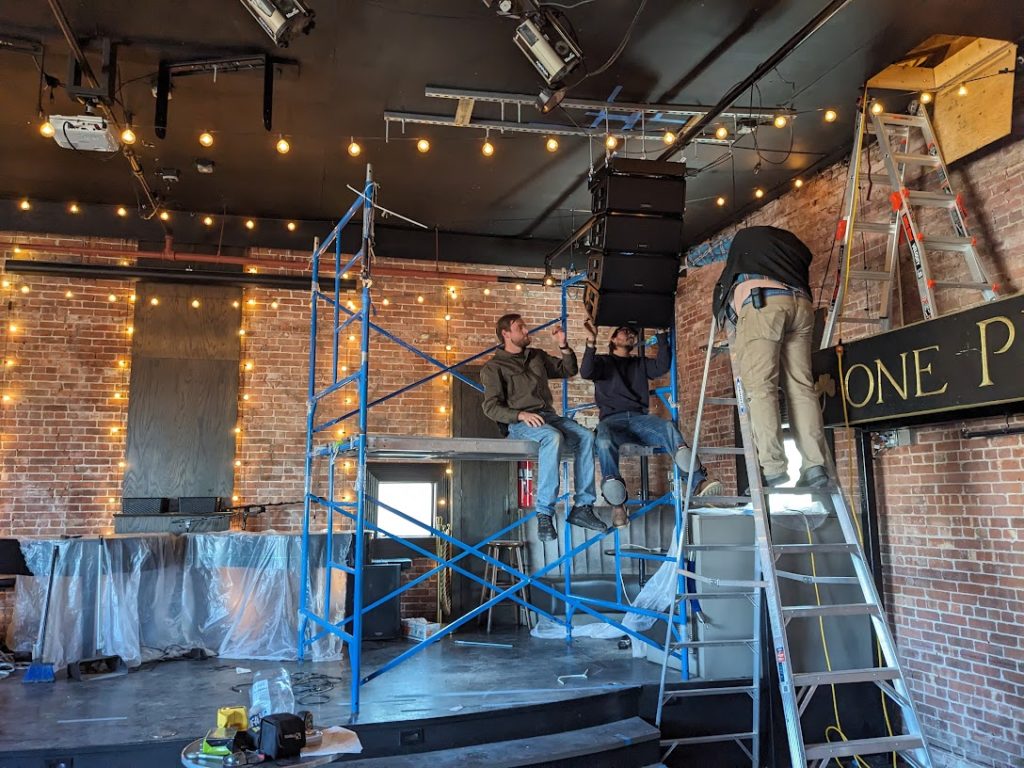
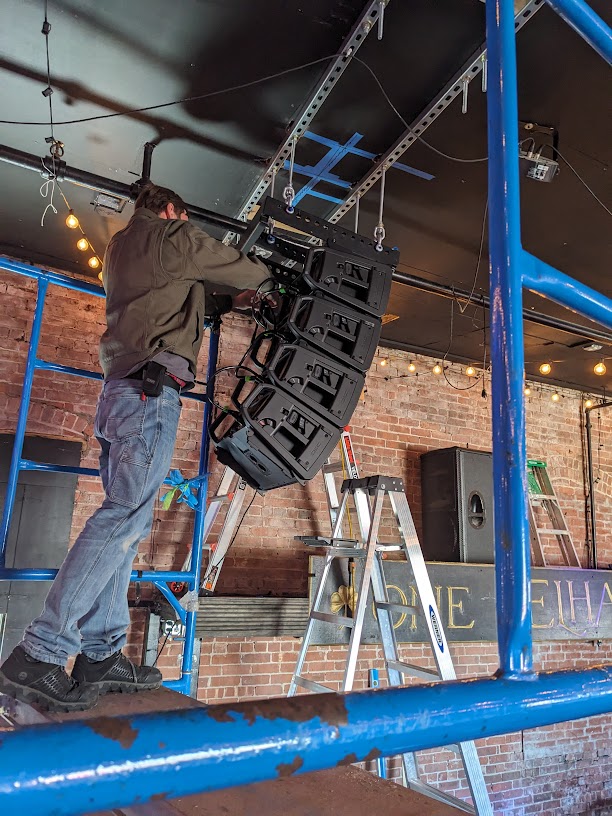
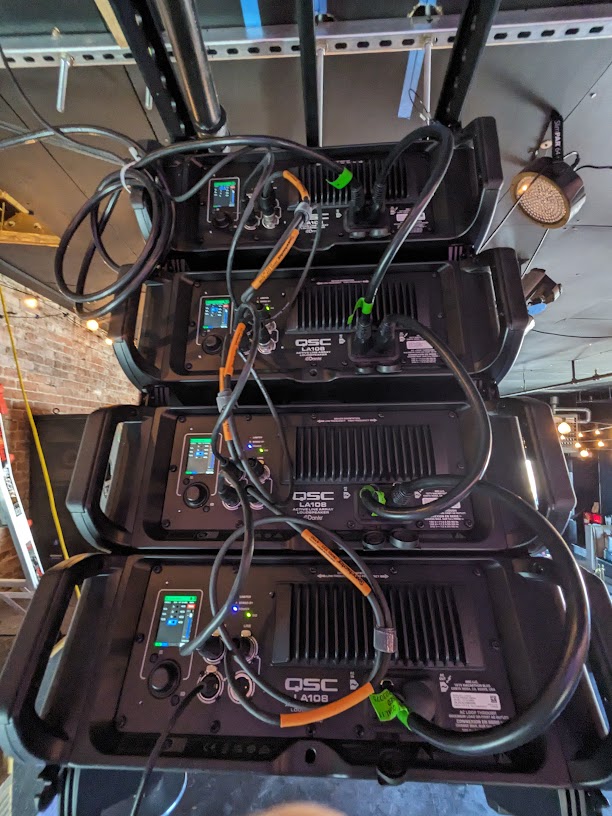
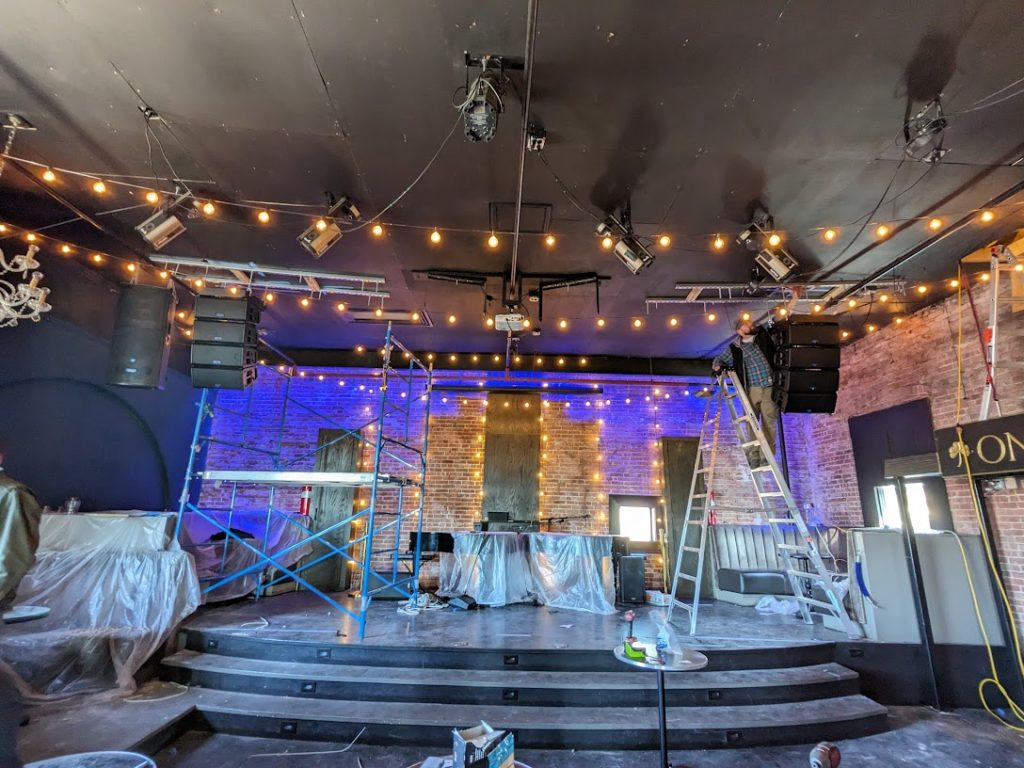
Well, the next month when I moved to Newport RI, I needed to find some more freelance work and I felt like I had a knack for this type of work. I visited all the venues downtown and one of them took big interest, One Pelham East. They not only wanted me to totally revamp their downstairs sound system, but they had also purchased some QSC line array boxes for their 3rd floor venue as directed by one of their musicians that plays there regularly.
I got to work, first attacking the downstairs. I took the exact model I used for Jackpocket, and applied it here. Their current system was a column array system that looks like it was installed completely wrong. If you walked in any direction from the center of the floor, you got comb filtering and dead spots every 3 feet, it was Bad. This time I gave them 5 levels of different budgets they could spend to replace their system; the most expensive being a complete L-acoustics overhaul (my buddy is a rep for them), and the least replacing it with some low budget QSCs. They elected to take the 2nd highest level and install some EAW AC6s, which are active column arrays with DSP technology to throw and disperse the audio in any direction you’d like.
While this was happening, I decided to help with the upstairs. Problem is, designing an audio system for recording is different from a system for live music. They have some similarities, like acoustic treatments, but the hardware has the opposite function, in stead of recording, it’s playing it back.
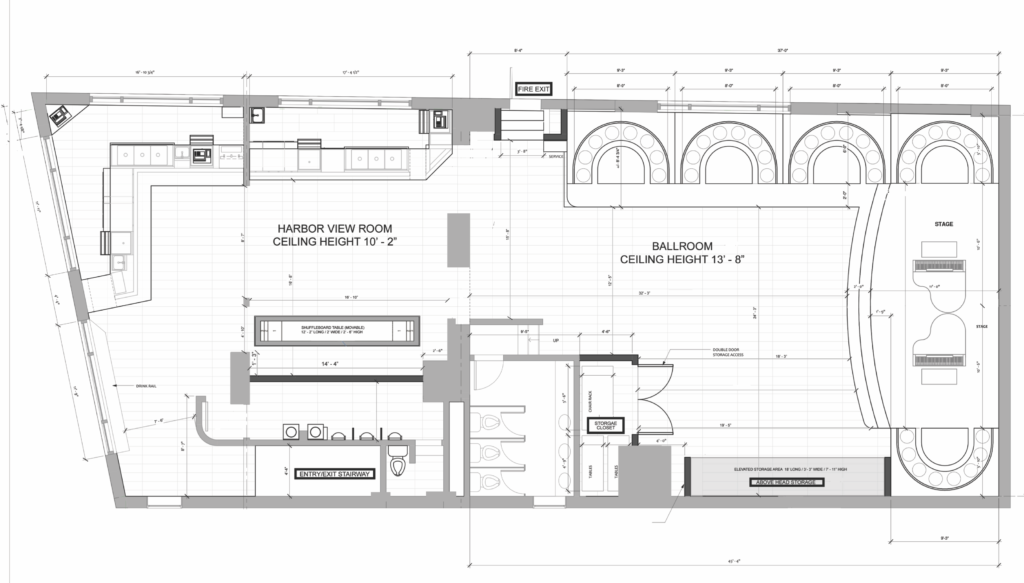
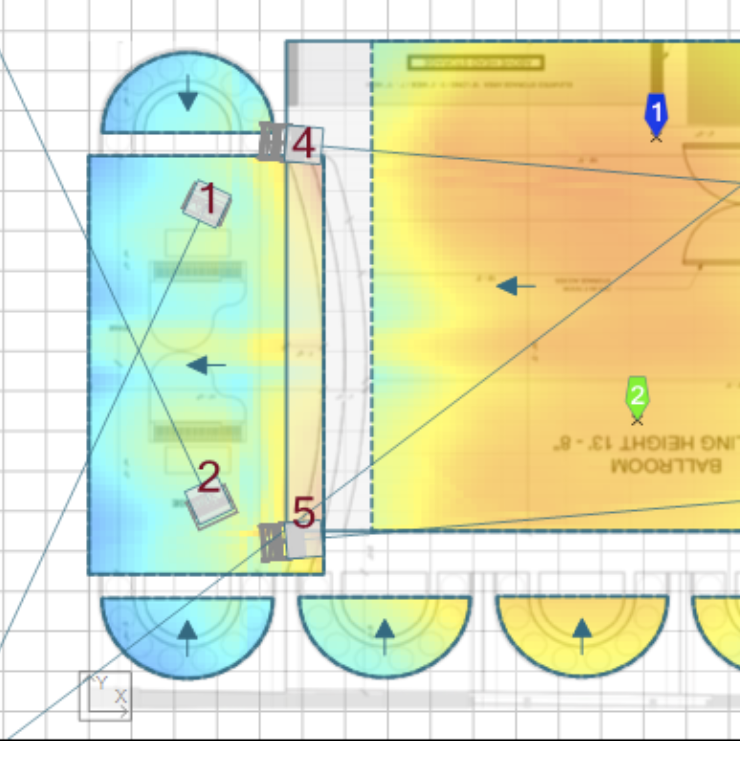
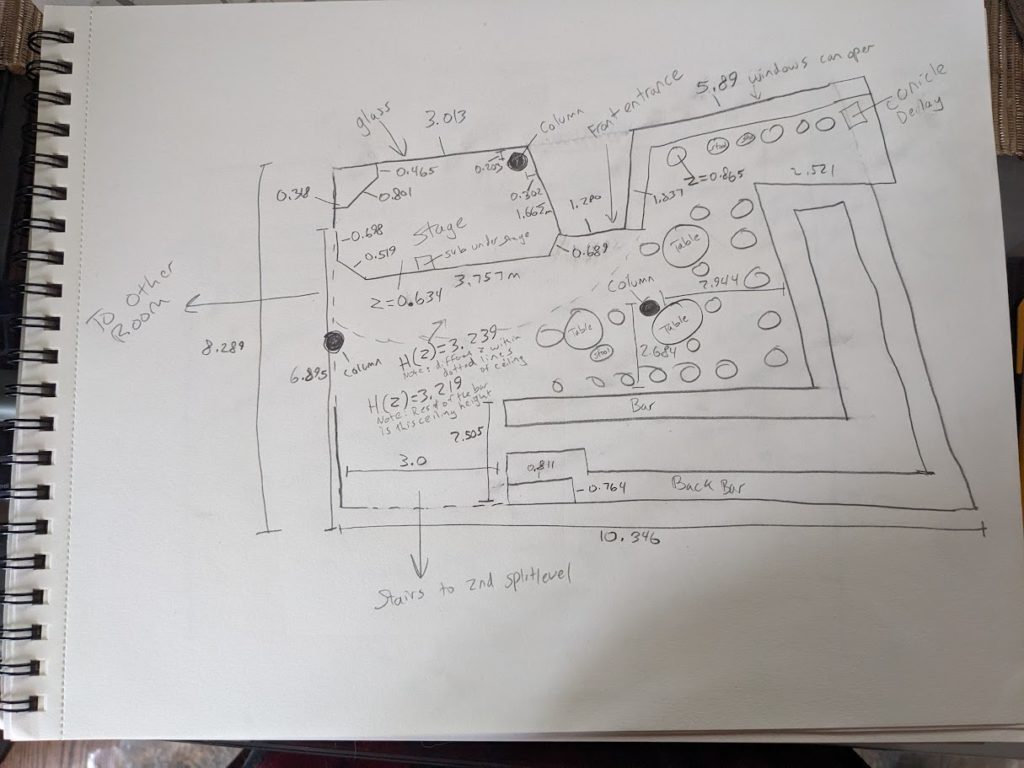
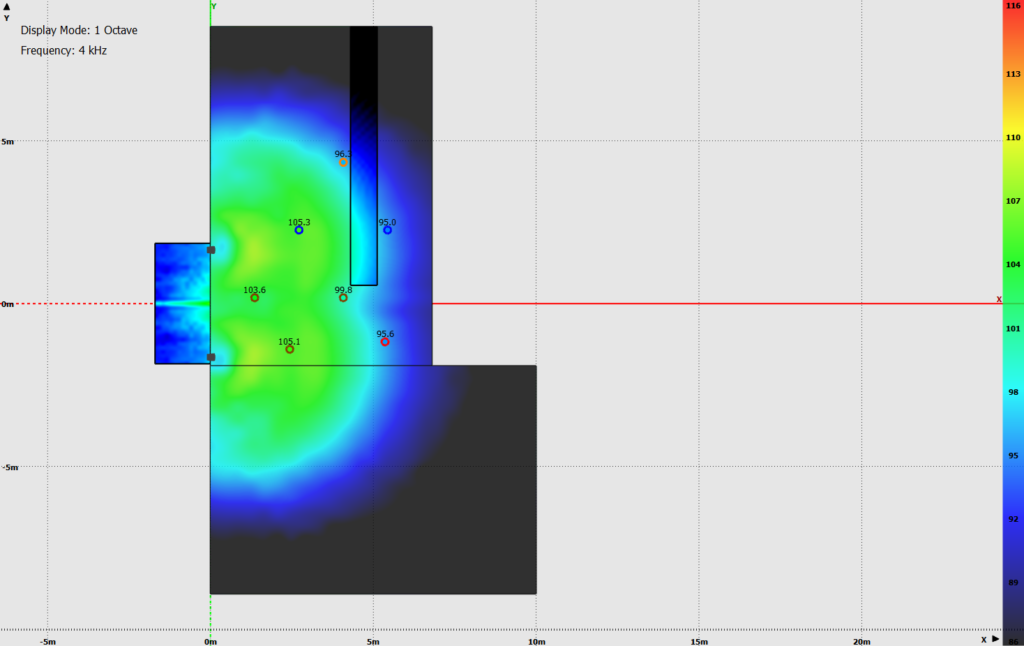
Through talking with EAW, they suggested learning EASE Focus, which allows you to take the specs of any pro-audio speaker and put it into a CAD like program to create a predictive model of the room. It also allows you to balance and optimize the location, rotation, splay, and tilt in 3D space. First I took some measurements of the space and used their existing blueprint.
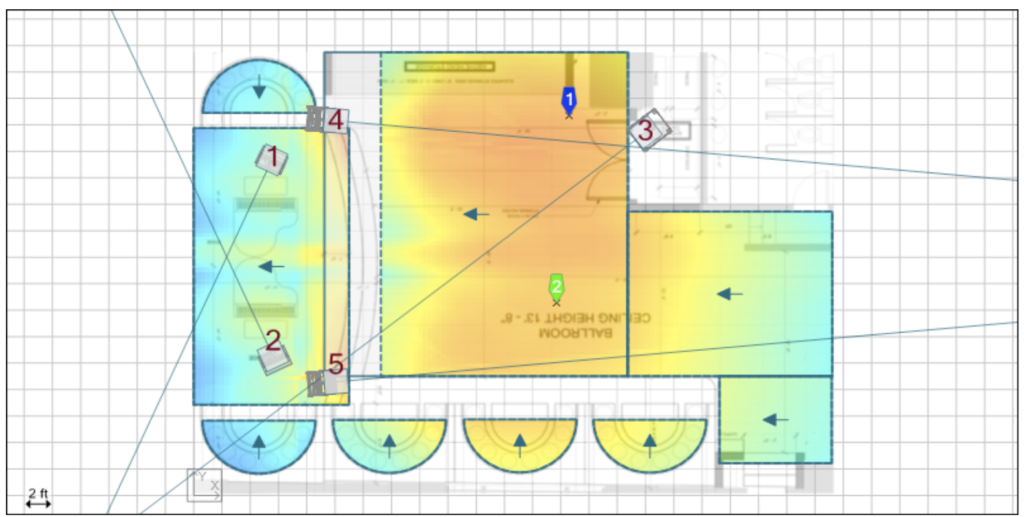
I am the rare kind of person who likes to learn from manuals. So I read the entire EASE Focus 6 manual and created a digital representation of all the listening areas in the space. Since the venue owners had already purchased the speakers they wanted to use (it wouldn’t have been my first choice), I just grabbed the specs from that manufacturer and imported it into the software. I was able to play around with all the different parameters to give a pretty decent coverage of the entire space from a SPL perspective (loudness).
The other thing the program allows you to do is take measurement of the frequency response in any spot in the venue. What I immediately noticed is that these 8″ line array boxes wouldn’t provide enough of the low end necessary to get a sonically balanced mix. And so I went to the manufacturer and tried out some different subs in this same program.
This worked out great because the sub I chose was 2x 12″s and the response graph showed a drastic improvement. The owners were happy so I worked with their installer and got these line arrays flown.
Meanwhile, the downstairs was coming along. The predictive models had come back from EAW. The adaptive nature of the EAW AC6s was of huge value to the owners because their bartenders were constantly having issue with the noise volume when taking customer orders, and with this, we could effectively cover the oddly shaped room’s dance floor and pull the coverage back around the bar area so the bartenders could spare their ears.
This 6 minute video was my final project at Berklee. The goal was to completely replace all of the audio with my own original sound design, film score, and ADR. A lot of the sounds you hear are a foley performance done by me. I used some stock sounds for dangerous things like explosions or gunfire. The ADR was acted by me, my friends, child actors, or some Emerson College students. The film score is original and it was composed and recorded by me using all VSTs and synthesizers. The final audio was mixed by me.
I’ve decided to put together a small sample of some my favorite keyboard performances over the past decade. All keyboards on these snippets are performed and written by me.
At the beginning of 2022 Wesley Birch and I officially started a business. A music studio, music label, and music publisher all wrapped into one. We call it Open Ocean Studios. Part of starting this business is to be able to release music that showcase artists from around the globe with a focus on musical language.
Our first release is part of a series called Tidal Waves which is a collaborative journey into completely improvised musical exploration.
Recorded on September 6th 2021 at Ocean Ocean Studios in Santa Barbara, CA Dorrien Schuyler – Rhodes Wes Birch – Guitar Andrew Freeborn – Synths Alexandre Hort – Bass Nick Moore – Drums