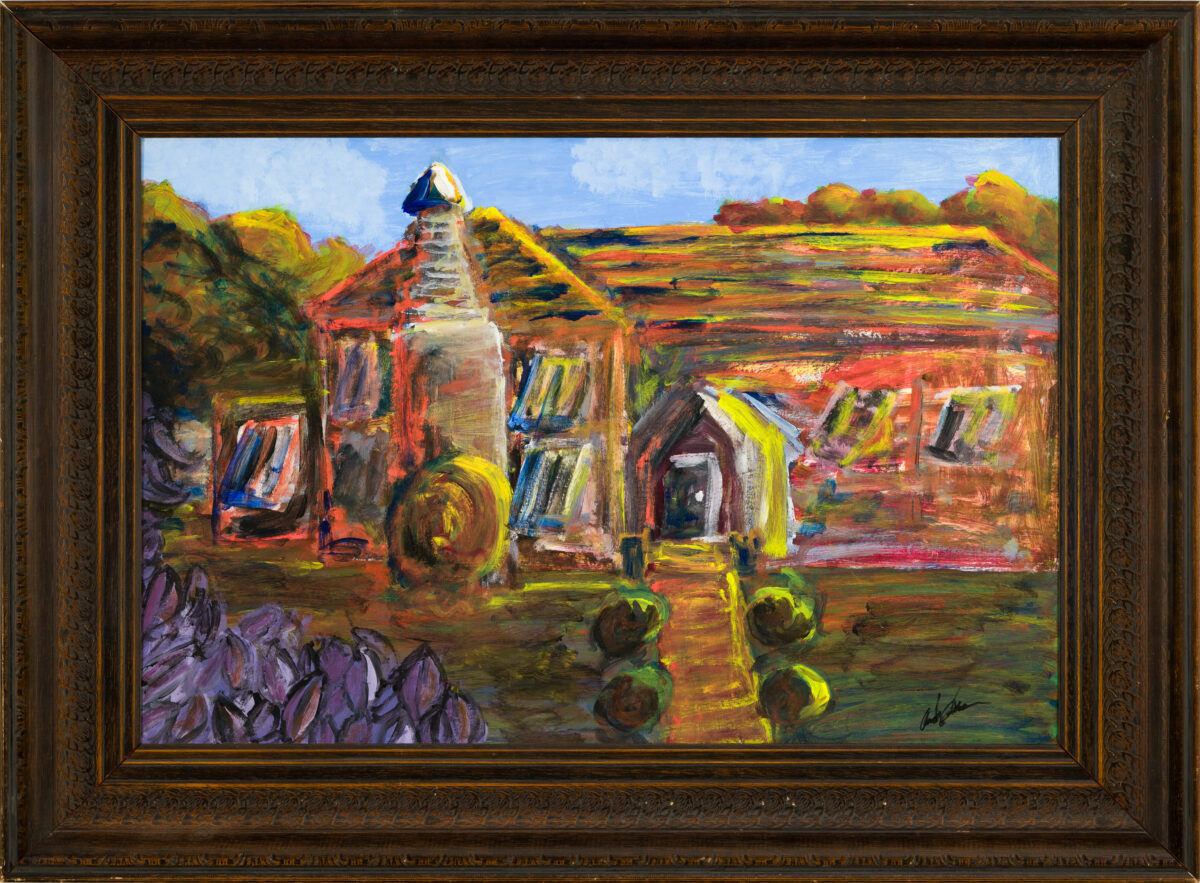
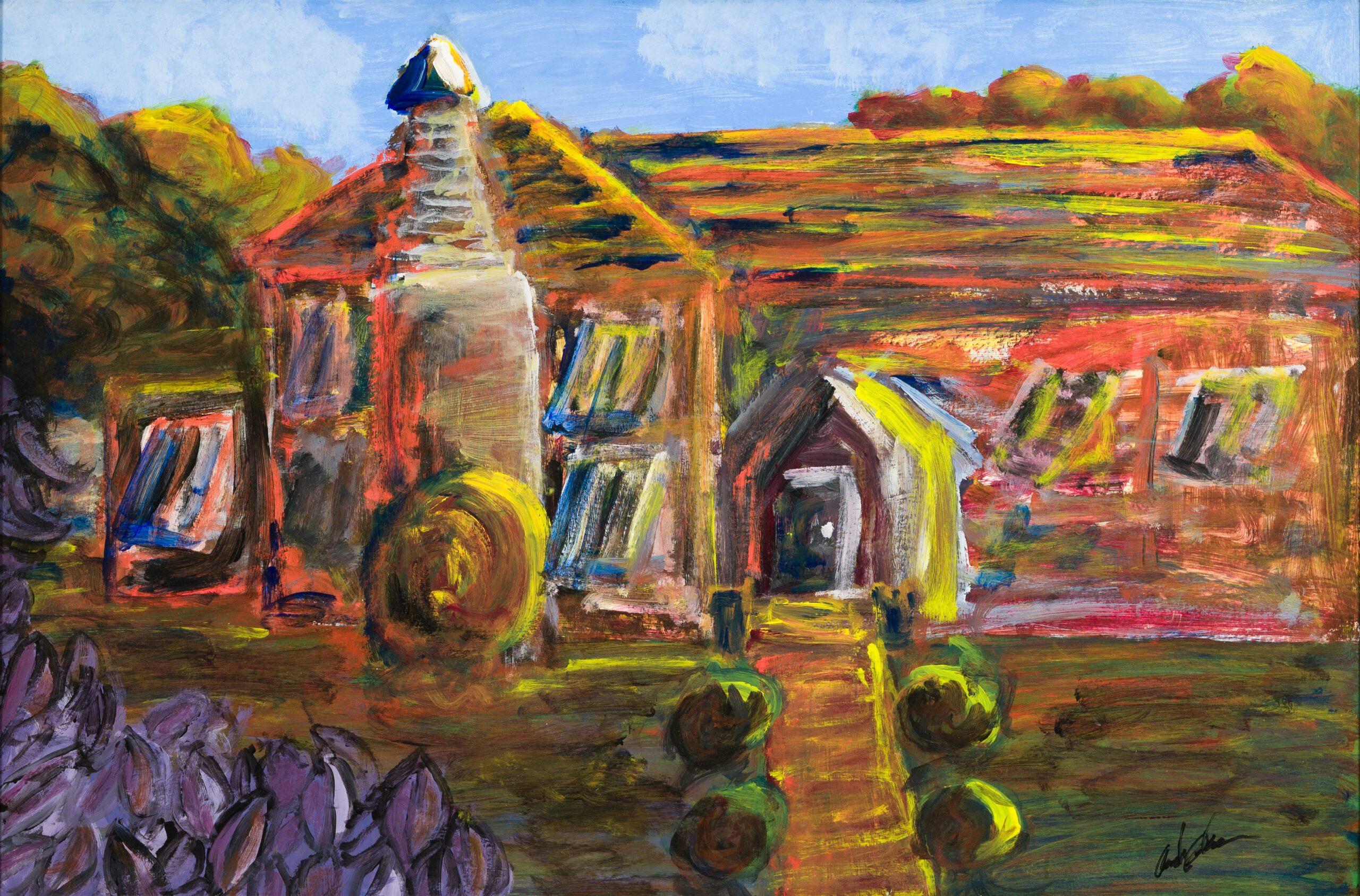
Bermuvibe 2

Acrylic on canvas. 29.5″ x 19.5″. Framed 38″ x 28″. 2003.

This one was a commission.

I lived in Bermuda. The colors come out of that, but they are imagined. None of it is what anything actually looked like, and that was deliberate. I was not trying to document a house. I wanted the painting to carry what the place felt like.

This is the second of three Bermuda paintings I made. The first went up here earlier this month. The third is still in the archive.

Painted in 2003, photographed for archival in February 2026, and shared here for the first time.

Bermuvibe 2, acrylic on canvas, 2003. The painted surface without the frame.
Bermuvibe 2, unframed.

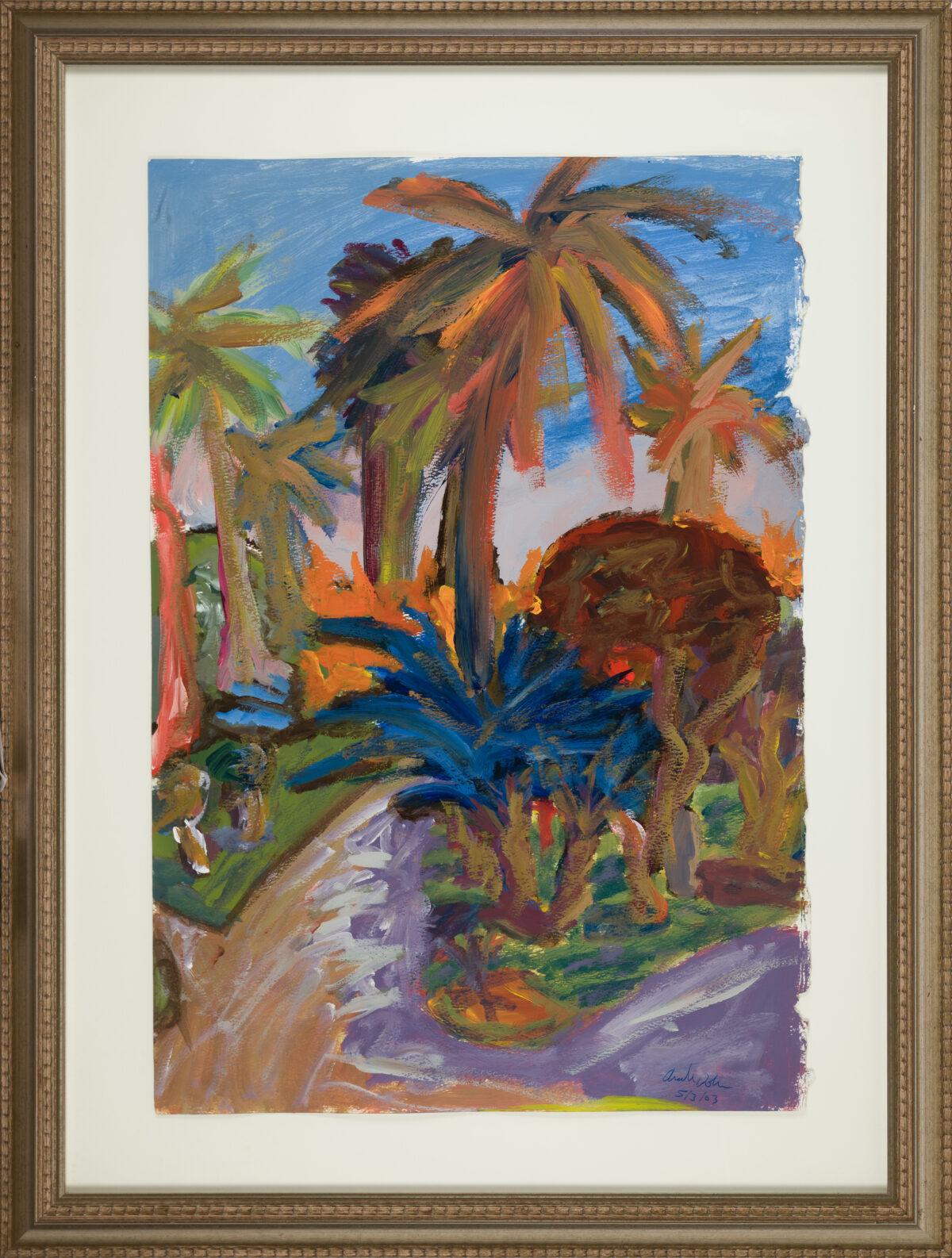
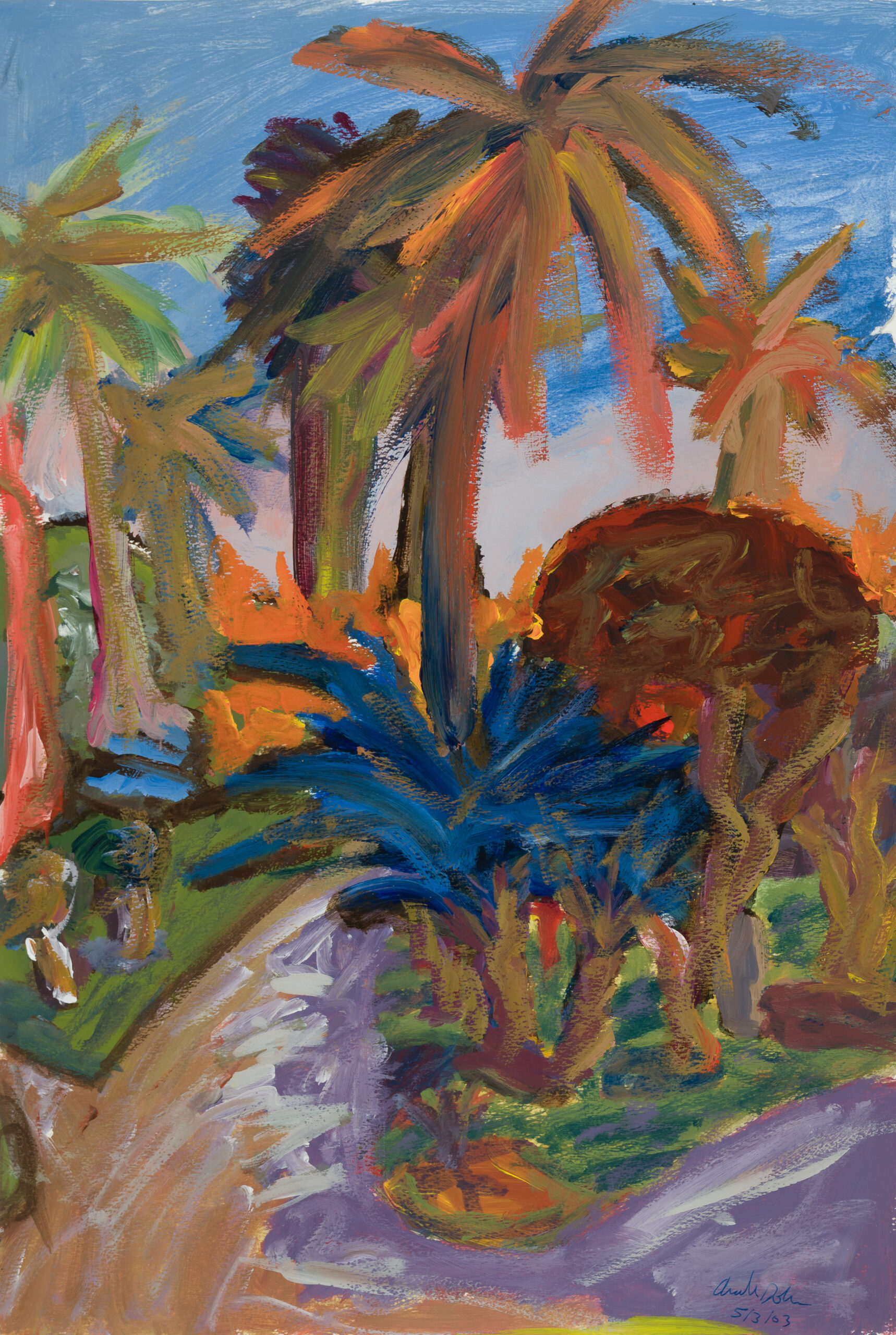
Bermuvibe 1

Acrylic on paper. Painted space 15″ × 22″. Framed 22″ × 29″. 2003.

I lived in Bermuda. I painted this in Roswell, Georgia, about two years after we moved away.

It is not a painting of something I was standing in front of. I worked from a photo of a real street somewhere on the island. The place is real. The color is not. I made that up.

That was deliberate. Bermuda was a lively place to live, bright and busy and full of exciting things going on, and that is what I wanted the painting to carry. Not a record of how anything actually looked.

This is the first of three Bermuda paintings I made. The other two are still in the archive.

Signed and dated on the painting: 5/3/03. Photographed for archival in January 2026. First time it has been shared.

Bermuvibe 1, acrylic on paper, 2003. The painted surface without the frame.
Bermuvibe 1, unframed.

Privacy Policy

Privacy Policy

Andrew Freeborn Creative LLC
Last updated: July 15, 2026

Overview

This privacy policy describes how andrewfreeborn.com collects and uses information when you visit this site. This is a personal portfolio website operated by Andrew Freeborn Creative LLC, based in Rhode Island.

Information Collected

This site may collect the following information:

  • Contact form submissions: If you submit a message via the contact form, your name, email address, and message content are collected solely to respond to your inquiry.
  • Server logs: Standard web server logs may record your IP address, browser type, referring page, and pages visited. This information is used for site security and performance only.

How Information Is Used

Information collected through this site is used only to respond to direct inquiries. It is not sold, rented, or shared with third parties for marketing or advertising purposes.

Third-Party Services

This site is built on WordPress. Please refer to the WordPress privacy documentation for information about their data practices.

Cookies

This site may use basic cookies required for WordPress functionality. No advertising or tracking cookies are used.

Your Rights

You may contact us at any time to request access to or deletion of any personal information you have submitted through this site.

Contact

Questions about this privacy policy can be directed to: creative@andrewfreeborn.com

2003 Charcoal Trees

Charcoal on paper. 18" × 24". 2003.

I don't remember making this. I would have been a junior in high school, in AP Art. That is about all I can tell you about the origin.

Pulling it out of storage earlier this year made me look twice. My first reaction was not that this was particularly special. Then it grew on me.

Part of what got me was the composition. There is no reference point in the piece, no horizon, no ground, nothing that tells you which way is up. I could have hung it upside down just as easily. I looked at it both ways and chose this orientation almost as a mini creative expression.

The other thing was recognizing my own hand in it. I have a lot of work from different periods, and when I look across it there are consistent threads: bold lines, compositions that push against the edges, a certain directness and sloppiness in the mark-making. This piece has all of that. Even without remembering making it, it is clearly mine, clearly in the same family as things I was making before and after. That recognition is what grabbed me. It did not feel like something I had discovered; it felt like something I had made, which is a different thing.

Photographed for archival in June 2026. First time it has been shared.

Am I Someone?

I pulled this out of an old portfolio recently. I had no memory of making it; no idea when, what I was thinking, or why it didn’t have a name. It had been sitting in there untouched for over twenty years.

In the summer of 2004 I was at SCAD (Savannah College of Art and Design) for a summer art program, on an architecture track. I was in a buddy’s dorm room. He’d brought an acoustic guitar. I had just learned “Is There Anybody Out There?” by Pink Floyd, which is a quiet, classical-sounding piece, and when I played it that day it hit me: I wanted to pursue music instead. Not because I didn’t love making art, I do, but because of the way music made me feel. That was the moment.

I went to Berklee after high school. The visual art kept happening in the background, the way it does when something’s yours but not yet public.

Looking at this piece now, it reads like that period. A lot of elements that don’t quite cohere, things pulled in different directions, patched together, not yet resolved. That’s an accurate picture of being seventeen. I titled it “Am I Someone?” because that’s the question I see in it.

Chalk pastel on paper. 2004.

What Ray Bradbury Taught Me About Letting Things Breathe

I have a folder on my hard drive full of MIDI music memos and rough recordings — ideas I’ve captured and then completely forgotten about. Every once in a while I’ll dig back through it, and something will stop me. Something I made a year ago, maybe two, that sounds fresh and surprising in a way I couldn’t have heard when I made it. I was too close to it back then and I couldn’t tell what it actually was.

I’ve always known this feeling. I didn’t know it had a name until I read the introduction to Ray Bradbury’s The Martian Chronicles.


Written in 1950 right after he turned in the final manuscript, Bradbury’s essay “How I Wrote My Book” was found in his home office files decades later and eventually published as part of the book’s deluxe edition. It’s not long. But it covers more ground than most books do — and the way it moves from one idea to the next is what got me.

He opens with craft. Specifically, the rotation system he built to write the Chronicles over five years. The idea was simple and familiar. Work hard on a story for a week, then file it away for six months. Move on to something else entirely. Finally, come back to it later with fresh eyes, rewrite it. Then repeat until it’s right.

His reasoning is that a story you’ve been grinding on for days hides its true face behind what he called “a mist of prejudice, tiredness, and boredom.” You can’t see it clearly. You’re too inside it. The only way to get the distance you need is to actually walk away — not for a few days, but for months — and let time do the separating for you.

That landed hard for me because the folder I mentioned earlier; that’s exactly what’s happening there. I’m marinating my ideas like a chicken breast in the fridge. The recording doesn’t change, but I do… When I come back, I’m closer to a listener than the person who made it and I can finally hear what it actually is.

Here’s where Bradbury pivots, and it’s seamless enough that you almost miss it.


He starts talking about what happens when a writer tries to produce on a market’s schedule — reacting to what editors want, slanting work toward what sells, chasing formulas. And you realize he’s describing the exact same problem, but one level up. The market is just another form of closeness; another thing that prevents distance. When commerce sets the timeline, you never get to walk away. You’re always in that, all-too-near relationship with your own work, and the authenticity gets squeezed out — not by bad intentions, but by the structure of the transaction itself.

He put it plainly: a writer who starts reacting to what editors want instead of what he actually thinks and feels is “over, done, finished and dead before he starts.”

Before writing anything, he’d ask: What do I actually think? What do I actually feel? What would I be afraid of, if I were dropped on Mars tonight? Not what would make a good story. Not what would sell. What’s actually true for me or for humanity.

That’s the only way you get to personal truth. It’s your balance between your filter and your wonder that makes things personal. Without it, it’s just the entirety of the universe existing. If a tree falls in the woods, does it make a noise?

And then he does it again. Another pivot, even bigger.


He draws a straight line from the individual creative act to human civilization at large. His whole premise for the Chronicles is that Mars is not a crystal ball, it’s a mirror. Whatever people bring with them in their suitcase and their soul, that’s all they’ll find there. The atom bomb follows you. Your politics follow you. Your habits follow you. You can outrun the speed of sound but you cannot outrun yourself.

It’s the same problem. We move fast, we produce, we export, and we never stop long enough to look at what we’re actually carrying. Bradbury imagined an Earth man arriving on Mars with his hot dog stands, his television, and his insistence on business as usual, and watched the whole expedition collapse under the weight of it.

He wasn’t writing science fiction. He was writing about what happens when you don’t let things breathe.


I think about this a lot in the context of how creative work gets made now. The pace of everything — content cycles, release schedules, social media, algorithms — is optimized for volume and immediacy. Which is the exact opposite of what Bradbury is describing. The system he built required slowness as a feature, not a workaround. The six months wasn’t wasted time. It was the work.

I don’t think you have to be a writer for this to apply. If you make anything from music to gardening to software code — you know the feeling of being too close to it. The thing that seems finished when you’re exhausted at midnight looks completely different at 10am two weeks later. That gap is information; the discomfort of the gap is the point.

Bradbury averaged three major stories a year under this system. Three. Not because he was slow, he was also writing fourteen other stories annually just to pay the bills. But for the work that actually mattered to him, he guarded the distance. He protected his own ability to see clearly.

I think that’s the real argument the essay is making, underneath everything else. Not just about writing, not just about commerce, not just about politics. It’s about what happens when you refuse to let anything sit long enough to become itself.

The folder on my hard drive is starting to make a lot more sense.


Ray Bradbury’s “How I Wrote My Book” was written October 17, 1950, and is included in the deluxe edition of The Martian Chronicles.

Archiving Artwork with Precision: Capturing the Truth

There is something sacred about preserving a piece of art.

A painting holds not only pigment and surface, but time. Brush strokes, texture, subtle shifts in tone—these are decisions. They are moments. And when we digitize artwork, the goal is not simply to “take a photo.” The goal is to honor those decisions with accuracy.

Over the past 2 years, I’ve refined a high-fidelity archival workflow that allows me to capture artwork exactly as it exists in real life—true color, true detail, zero glare, and full resolution integrity. Whether the piece is framed behind glass, painted in oil with reflective texture, or completely unframed, the result is the same: archive-level clarity and precision.


The Gear & Foundation

My archival setup is built around control and repeatability:

  • Nikon Z5 full-frame mirrorless camera
  • NIKKOR Z MC 50mm f/2.8 macro lens (edge-to-edge sharpness with minimal distortion)
  • 2x Rosco Polarizing #7300 filters (17” x 20”)
  • K&F Concept Nano-X Circular Polarizer (lens mounted)
  • 2x RALENO 16” x 16” Softboxes (5500K | 97 CRI | TLCI ≥97)
  • X-Rite Color Passport & calibration software
  • Lightroom Classic
  • Mac Mini M2 Pro
  • Professional easel mounting system

But gear alone isn’t what creates accuracy. The workflow does.


Step 1: Controlled, Even Lighting

The painting is mounted vertically or horizontally on an easel. Two softboxes are placed at equal height and equal distance on either side, angled at roughly 45 degrees to the surface. This placement ensures even illumination across the entire piece and prevents falloff from one side to the other.

The lights are balanced at 5500K daylight temperature, creating a neutral and consistent baseline before any color correction begins.


Step 2: Cross-Polarization (Eliminating Glare Completely)

Each softbox is fitted with a linear polarizing sheet. A circular polarizer is mounted on the lens. By rotating the lens filter to counteract the polarization direction of the lights, reflected light is cancelled out.

  • Glass reflections disappear.
  • Gloss varnish no longer produces hot spots.
  • Metallic or textured paint loses specular glare.

What remains is pure surface information.

This allows me to faithfully capture:

  • Framed works behind glass
  • High-gloss oil paintings
  • Heavy impasto texture
  • Mixed media surfaces

Without polarization, archival photography requires so much comprimse. It wouldn’t allow for high-gloss paint and museum glass framed paintings.


Step 3: Color Accuracy & Profiling

Before photographing the artwork, I set up my camera to all manual settings so that I’m not working with a moving goal post. Then I capture an image of the X-Rite Color Passport and a grey card under the exact same camera settings and lighting conditions of the final photo. Using the calibration software, I generate a custom color profile specific to that session’s lighting and camera configuration.

This profile is then applied in Lightroom Classic to my x-rite calibrated monitor. This allows me to see the truth.

The result is not “adjusted color”—it is corrected color. Whites become neutral. Reds stop oversaturating. Subtle tonal transitions remain intact. What appears on the calibrated monitor matches what exists in physical space.

The goal is simple: the digital file should look indistinguishable from the artwork under neutral light.


Step 4: Resolution & Micro-Detail

The Nikon Z5 paired with the 50mm macro lens produces exceptional clarity across the frame. When viewed at 100% zoom, individual canvas fibers, brush ridges, and micro-transitions in pigment remain sharp and natural.

The Macro lense has a special final glass layer that minimizes aberrations and distortions of the image.

This level of detail is essential for:

  • Fine art print reproduction
  • Archival documentation
  • Gallery submissions
  • Portfolio websites

The intention is never to “enhance” or stylize the piece. The intention is truth and fidelity.


Step 5: High-Fidelity Export

From Lightroom Classic, I generate exports tailored to their purpose:

  • High-resolution archival TIFFs
  • Print-ready files in appropriate color spaces
  • Web-optimized JPEGs with embedded metadata

Whether the piece is small or large, framed or unframed, under glass or raw canvas, the workflow scales. The lighting geometry, polarization, and color calibration remain consistent.

With Frame

With Frame, Cropped


Why This Matters

Archival photography is not simply documentation—it is preservation.

As artists, our work deserves to be represented accurately long after it leaves the studio. Collectors, galleries, insurers, and publishers all rely on digital reproductions. If those reproductions are flawed—incorrect color, glare, distortion—then the artwork itself is misrepresented.

For me, this process mirrors how I approach product development: understand every variable, control the system, remove uncertainty, and build a repeatable framework.

Light angle. Polarization direction. Color temperature. Lens distortion. Export color space. When each variable is accounted for, the final image stops being a “photo of a painting.” It becomes a faithful digital twin of the original.

If you’re an artist looking to preserve your work with precision and integrity, I’d love to connect.

Exploring Orbis Analysis: A Systematic Approach to Product Development

I recently earned a certification in Orbis Analysis, a structured approach to product development designed by Malcolm Knapp. This system provides a way to take a product idea and systematically break it down into four key elements:

  1. Schematic – A detailed diagram illustrating the product’s structure and components.
  2. Behavior Flow Chart – A visual representation of how the product functions in different scenarios.
  3. System of Connections – A complementary diagram showing how various components interact in ways that the schematic alone cannot convey.
  4. Hierarchy List – A nested breakdown of the product, organizing its assemblies and subassemblies in a structured manner.

For my certification project, I applied Orbis Analysis to a real-world product: my open-back Shure SRH-1840 headphones. This exercise provided valuable insights into the intricacies of product design and demonstrated how this method can enhance the early stages of development.

Breaking Down the Shure SRH-1840 Headphones

Schematic: Visualizing the Product’s Structure

The first step was creating a schematic representation of the headphones. I was surprised by the complexity required to fully illustrate the design. The process involved encapsulating different assemblies and using breakout diagrams to show how components fit together. This detailed visualization proved invaluable in understanding the scope of the product and the relationships between various elements.

Behavior Flow Chart: Mapping Functional Interactions

Next, I developed a behavior flow chart, outlining how the headphones operate based on their user manual. This step initially felt uncertain, but referencing the manufacturer’s documentation provided clarity. This process reinforced the importance of defining a product’s expected behaviors before diving into detailed design work.

System of Connections: Understanding Component Interactions

The system of connections expanded on the schematic by illustrating relationships that a static diagram cannot fully capture. This was particularly useful in identifying dependencies and potential design constraints early in the process.

Hierarchy List: Organizing Components Logically

Finally, I created a hierarchical breakdown of the headphones. While this was a tedious step, it helped clarify the technical specifications of each component. This structured approach aids in selecting off-the-shelf components and designing custom elements where necessary. Additionally, it provides a solid foundation for the bill of materials (BOM) and understanding parent-child relationships in a product’s architecture.

Key Takeaways: Advantages and Limitations

The Orbis Analysis method offers significant benefits for product development, especially in the early stages:

  • Uncovering Roadblocks Early – By mapping out every component and interaction beforehand, potential design challenges become apparent before significant resources are invested.
  • Facilitating a High-Level Perspective – This approach allows teams to begin developing a product without needing immediate input from all technical disciplines.
  • Aiding BOM Creation – The hierarchy structure naturally leads into a well-organized bill of materials, streamlining procurement and manufacturing planning.

However, one limitation I found was that Orbis Analysis is platform-agnostic. While this flexibility can be useful, having a proprietary platform to structure the four pillars systematically could enhance usability and adoption.

Final Thoughts: Strengthening Product Development & Project Management Skills

As a project manager, I see immense value in Orbis Analysis for laying out a product vision before diving into the details. It helps bridge the gap between concept and execution, making it easier to align teams and resources effectively.

I hope this certification will further demonstrate my product development and project management capabilities. My goal remains to work in music technology, and this structured approach aligns well with the complexities of audio hardware design.

If you’re involved in product development or project management, I highly recommend exploring Orbis Analysis. It’s an excellent framework for ensuring a solid foundation before moving into detailed design and production.

KNOWING YOU, AS ME

Imagine a glove with the fingertips cut off. From the perspective of the finger, it is alone. Each finger moves independently. It believes itself to be distinct from the others, unaware that beneath the glove, all the fingers are connected to the same hand. 

This is how we experience consciousness. We move through life as separate selves, bound by identity, beliefs, and experience, unaware that beneath the surface, we are all expressions of the same awareness. The hand is consciousness itself, but the glove—our individual ego, our sense of self—creates the illusion of separateness.

Alan Watts put it simply: “You are something the whole universe is doing in the same way that a wave is something the whole ocean is doing.” When we begin to see through the glove, we recognize that we are not just individual waves, rising and falling in isolation, but the entire ocean moving as one. The realization that you and I are the same being, peering at each other through different eyes, is what allows true compassion to emerge.

A good practice is imagining yourself as any other person; your partner, a family member, or a friend. Sitting, breathing, and using your imagination to actually view the world through that person’s eyes. But this is no exercise… This is the truth. The single consciousness of humans is simultaneously conscious in all people. Meaning, me imagining myself living through the eyes of someone else is no imagination at all, it is reality as the consciousness doing the imagining is the same exact consciousness living in that other body.

But when you see with clear eyes, when you recognize that the same awareness flows through all things, the illusion crumbles. You are not just the finger—you are the hand. You are not just the wave—you are the ocean. And in this realization, compassion is no longer an effort; it becomes the only natural response.

Ram Dass spoke often about this connection with Hanuman, a Hindu deity.

He told us a parable in which Rama, another Hindu deity, asked Hanuman, “What are you, monkey?”

Hanuman replied,
“When I don’t know who I am, I serve you. When I know who I am, I am you.” 

When you dissolve the illusion of separateness, every interaction becomes an opportunity to recognize yourself in another. The anger you hurl at someone else is anger you are hurling at yourself. The kindness you offer another is the kindness you extend to yourself. Love and hatred, connection and conflict—they all exist within the same unified field of being.

To live from this awareness is not to abandon individuality, but to see through it. It is to dance in the paradox of being both a wave and the ocean, both the finger and the hand. It is to recognize that in every face you meet, you are looking into a mirror. And once you see this—truly see it—you can never unsee it.

The only thing left to do is love.

WE ARE THE CONSCIOUSNESS OF THE PLANET

It’s easy to fall into the illusion of separateness, to believe that we are individuals distinct from the Earth we stand on. But this is a misunderstanding, a trick of the mind. Just as the cells in our bodies work in harmony to sustain us—each with its own function, from the heart pumping blood to the lungs drawing breath—so too does the Earth operate as a single, living entity. And we? We are its consciousness.

Alan Watts once said, “You are an aperture through which the universe is looking at and exploring itself.” The same can be said about our relationship with the Earth. The planet, through us, gains self-awareness. It grew us—not apart from itself, but as an extension of its own being, just as a tree grows branches or a river carves its path. Humanity is not separate from nature; we are nature reflecting upon itself.

This consciousness is not exclusive to humans. It is an aggregate of all life—animals, plants, fungi, even the microbial world—all part of a vast, interconnected intelligence. Carl Jung spoke of the collective unconscious, a shared psychic reservoir that all beings contribute to and draw from. The Earth, too, has its own collective awareness, formed by the thoughts, instincts, and emotions of everything that lives upon it. When a flock of birds moves as one, when trees communicate through mycelial network, when an ecosystem thrives in perfect balance, we see glimpses of this planetary intelligence at work.

If Earth is a conscious entity, then surely other planets must be as well. Some may have developed consciousness in ways we can’t yet imagine. What would the self-awareness of a gas giant look like? A planet covered in oceans? A world where life moves at a pace so slow or so fast that it defies our understanding of perception? If we are the Earth’s way of knowing itself, then other planets, too, must have their own ways of awakening.

Krishnamurti once said, “You are the world, and the world is you.” This is not metaphorical—it is a literal truth. We are the sensory organs, the dreaming mind, the reflective awareness of the planet itself. And as we awaken to this reality, we have the opportunity to live in harmony with the Earth, not as masters of it, but as conscious participants in its evolution.

To recognize our role as the Earth’s awareness is to dissolve the illusion of separation. It is to see that we are not in nature—we are nature. And just as a healthy mind nurtures its body, a conscious humanity must nurture its planet.

A beautiful reflection of this idea can be found in Nature, a song by East Forest & Ram Dass. In the track, Ram Dass’ words serve as a gentle but profound truth that humans must dissolve the barriers between ourselves and the planet in order to fully prosper as a species. Check it out.